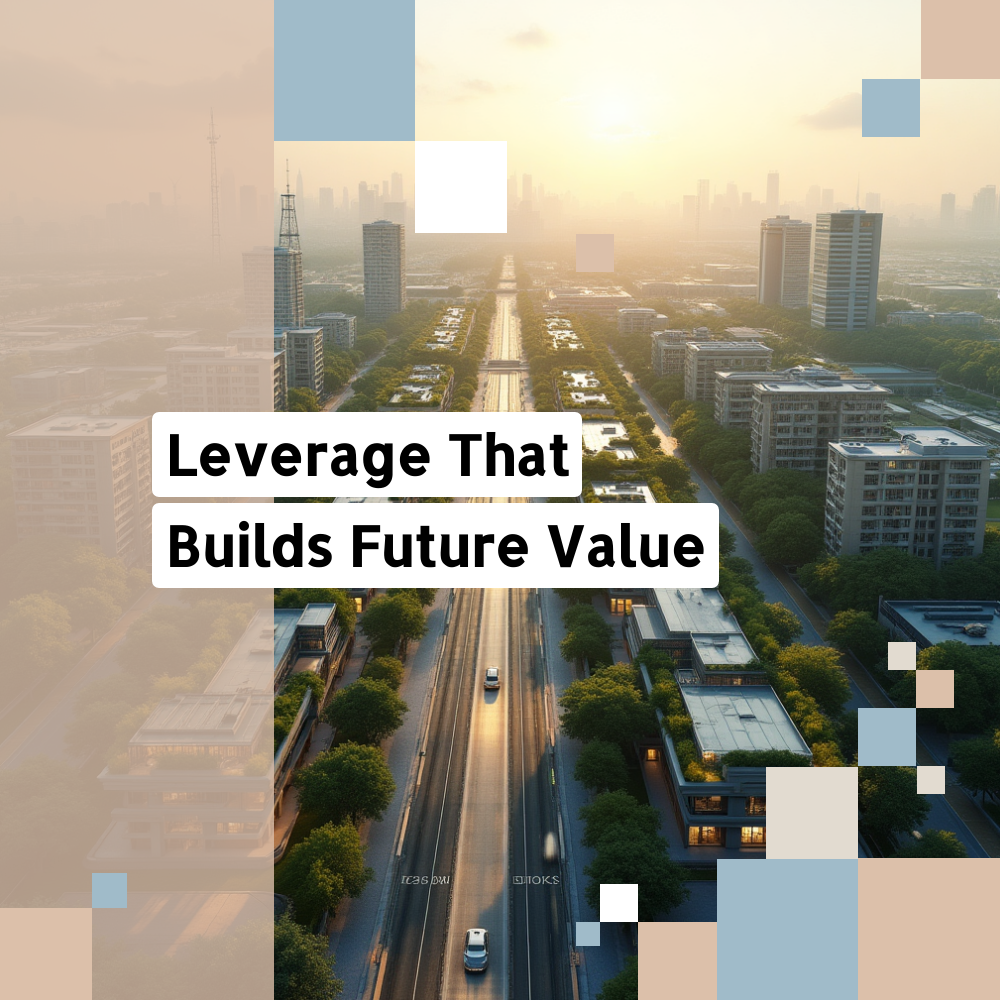
In real estate, a simple sentence can reveal an entire philosophy. “Now do it with leverage” may sound tactical, even casual, but beneath it lies one of the most consequential questions in development: what exactly are we amplifying?
Leverage is rarely just financial. Yes, capital can accelerate land assembly, infrastructure, and delivery timelines. But in the built environment, leverage also comes from data, policy alignment, public trust, mobility networks, and increasingly, from technology that helps us see second- and third-order effects before concrete is poured. The real issue is not whether we use leverage. It is whether we use it intelligently.
For too long, the industry has treated leverage as a multiplier of speed and scale. Build faster. Acquire more. Densify quickly. Extract value efficiently. There is logic in that approach, but it is incomplete. If leverage only increases output, we may end up amplifying the wrong patterns: disconnected districts, brittle infrastructure, speculative land use, and places that perform well on a spreadsheet but poorly in human life.
This is why I believe the next generation of real estate strategy must redefine leverage as the ability to create compounding social and spatial value over time. A well-placed transit corridor is leverage. A zoning framework that rewards mixed-use resilience is leverage. A digital planning model that helps simulate heat, traffic, and public realm activity before approval is leverage. So is community engagement done early enough to shape design rather than merely react to it.
The most sophisticated cities are already moving in this direction. They understand that the strongest projects are not those with the highest initial velocity, but those with the best long-term feedback loops. When technology is integrated thoughtfully—GIS, scenario modeling, digital twins, AI-assisted planning—it can turn development from a linear transaction into a living system of informed decisions. That shift matters. It allows us to ask not only “Can this site carry more density?” but also “Can this neighborhood absorb more life?”
As someone who has spent years at the intersection of land strategy, planning, and development, I’ve come to see leverage as a moral instrument as much as a financial one. It exposes intent. If a project gains power, what does it empower? More access? More adaptability? More belonging? Or simply more extraction?
The status quo still rewards visible momentum. But cities do not fail from lack of activity; they fail from misdirected acceleration. In that sense, leverage should be handled with the same care as infrastructure itself: designed for durability, calibrated to context, and accountable to the people who will live with its consequences.
Perhaps the more interesting question is not whether we can do it with leverage, but whether we have learned what deserves to be multiplied.
Leverage is rarely just financial. Yes, capital can accelerate land assembly, infrastructure, and delivery timelines. But in the built environment, leverage also comes from data, policy alignment, public trust, mobility networks, and increasingly, from technology that helps us see second- and third-order effects before concrete is poured. The real issue is not whether we use leverage. It is whether we use it intelligently.
For too long, the industry has treated leverage as a multiplier of speed and scale. Build faster. Acquire more. Densify quickly. Extract value efficiently. There is logic in that approach, but it is incomplete. If leverage only increases output, we may end up amplifying the wrong patterns: disconnected districts, brittle infrastructure, speculative land use, and places that perform well on a spreadsheet but poorly in human life.
This is why I believe the next generation of real estate strategy must redefine leverage as the ability to create compounding social and spatial value over time. A well-placed transit corridor is leverage. A zoning framework that rewards mixed-use resilience is leverage. A digital planning model that helps simulate heat, traffic, and public realm activity before approval is leverage. So is community engagement done early enough to shape design rather than merely react to it.
The most sophisticated cities are already moving in this direction. They understand that the strongest projects are not those with the highest initial velocity, but those with the best long-term feedback loops. When technology is integrated thoughtfully—GIS, scenario modeling, digital twins, AI-assisted planning—it can turn development from a linear transaction into a living system of informed decisions. That shift matters. It allows us to ask not only “Can this site carry more density?” but also “Can this neighborhood absorb more life?”
As someone who has spent years at the intersection of land strategy, planning, and development, I’ve come to see leverage as a moral instrument as much as a financial one. It exposes intent. If a project gains power, what does it empower? More access? More adaptability? More belonging? Or simply more extraction?
The status quo still rewards visible momentum. But cities do not fail from lack of activity; they fail from misdirected acceleration. In that sense, leverage should be handled with the same care as infrastructure itself: designed for durability, calibrated to context, and accountable to the people who will live with its consequences.
Perhaps the more interesting question is not whether we can do it with leverage, but whether we have learned what deserves to be multiplied.