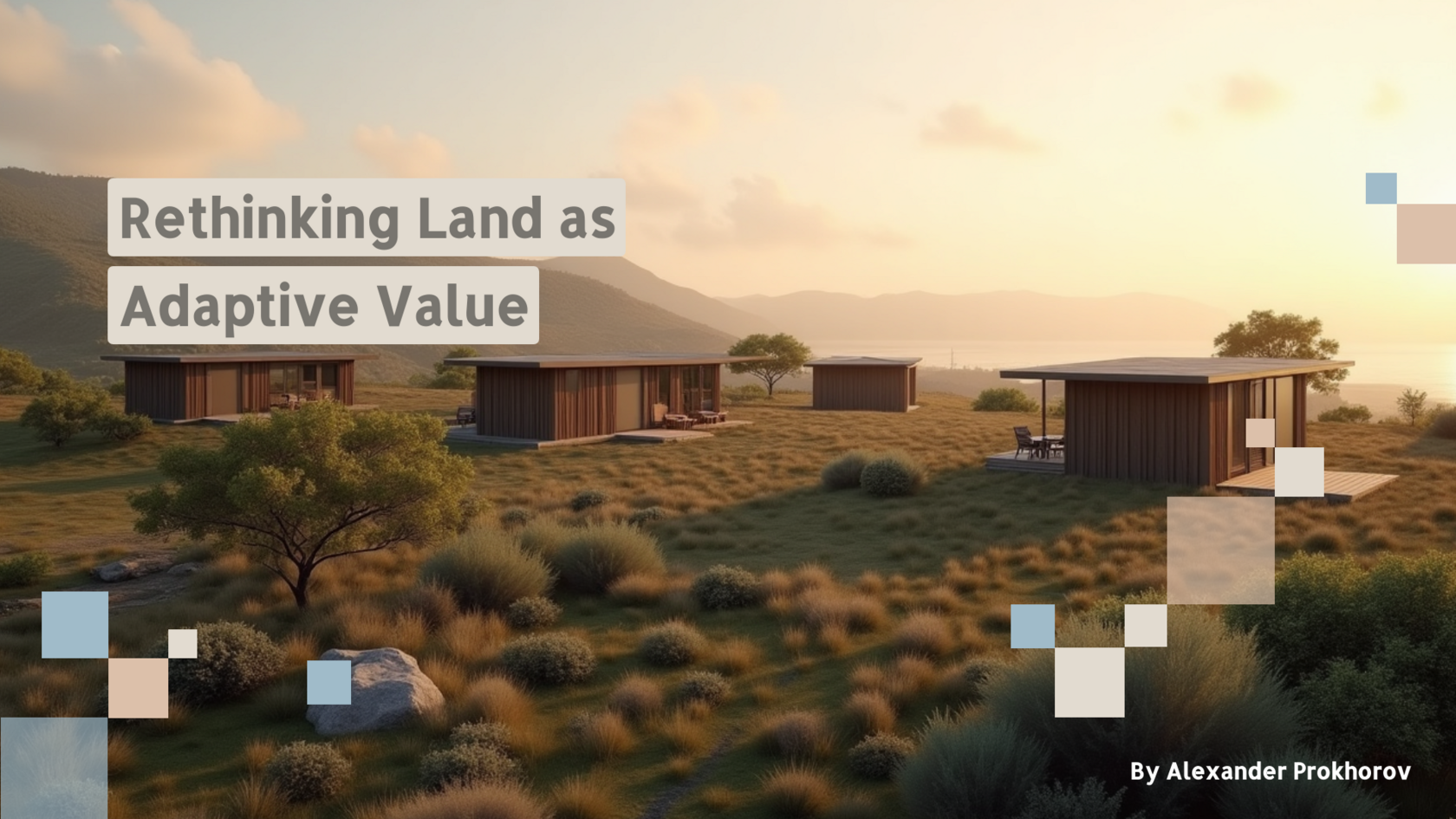
For decades, land has been framed too narrowly: as something to hold, to subdivide, or to build upon once. That mindset belongs to a more static era. Today, land should be understood as a platform — one that can host layered uses, evolving revenue models, and more adaptive forms of living and hospitality.
What some now call “land hacking” is interesting not because it is trendy, but because it reveals a deeper shift in how value is created. A parcel is no longer defined only by its acreage or a single primary residence. Its true potential may lie in how intelligently we organize infrastructure, experience, access, and flexibility over time.
The example of five tiny homes generating nearly $500,000 in annual gross revenue is striking, of course. But the real lesson is not about short-term yield. It is about design intelligence. Small-format structures — geodesic domes, A-frames, mirrored cabins — are not merely aesthetic products for social media. At their best, they are low-footprint tools for testing demand, diversifying land use, and creating a lighter relationship between development and landscape.
This matters because conventional real estate development is often too binary. We either underuse land or overbuild it. In between, there is a more nuanced path: incremental activation. Add one unit, then another. Learn from occupancy patterns. Improve utilities. Introduce shared amenities. Refine the operating model. This is closer to venture-building than to traditional construction — and in many cases, more resilient.
From an urban planning perspective, this approach also raises an important challenge. If we truly believe in more sustainable, human-centered development, then we should not romanticize “raw land” as empty, nor should we default to sprawl disguised as opportunity. The question is not simply how many structures can fit on a site. The question is whether the land is being stewarded in a way that improves its ecological, social, and economic performance simultaneously.
Technology will increasingly shape this frontier. Better site analytics, modular construction, off-grid utilities, AI-driven pricing, and remote property operations now make it possible to activate land with far more precision than before. That changes the role of the landowner. They are no longer just an owner or builder; they become a curator of an ecosystem.
And this is where the conversation becomes more important than the revenue headline. The most valuable projects in the next decade will not be those that simply “fit more” onto land, but those that make land more intelligent, more adaptable, and more meaningful for the people who experience it.
Perhaps the future of land is not in building bigger things, but in building systems that allow a place to become more alive over time.
What some now call “land hacking” is interesting not because it is trendy, but because it reveals a deeper shift in how value is created. A parcel is no longer defined only by its acreage or a single primary residence. Its true potential may lie in how intelligently we organize infrastructure, experience, access, and flexibility over time.
The example of five tiny homes generating nearly $500,000 in annual gross revenue is striking, of course. But the real lesson is not about short-term yield. It is about design intelligence. Small-format structures — geodesic domes, A-frames, mirrored cabins — are not merely aesthetic products for social media. At their best, they are low-footprint tools for testing demand, diversifying land use, and creating a lighter relationship between development and landscape.
This matters because conventional real estate development is often too binary. We either underuse land or overbuild it. In between, there is a more nuanced path: incremental activation. Add one unit, then another. Learn from occupancy patterns. Improve utilities. Introduce shared amenities. Refine the operating model. This is closer to venture-building than to traditional construction — and in many cases, more resilient.
From an urban planning perspective, this approach also raises an important challenge. If we truly believe in more sustainable, human-centered development, then we should not romanticize “raw land” as empty, nor should we default to sprawl disguised as opportunity. The question is not simply how many structures can fit on a site. The question is whether the land is being stewarded in a way that improves its ecological, social, and economic performance simultaneously.
Technology will increasingly shape this frontier. Better site analytics, modular construction, off-grid utilities, AI-driven pricing, and remote property operations now make it possible to activate land with far more precision than before. That changes the role of the landowner. They are no longer just an owner or builder; they become a curator of an ecosystem.
And this is where the conversation becomes more important than the revenue headline. The most valuable projects in the next decade will not be those that simply “fit more” onto land, but those that make land more intelligent, more adaptable, and more meaningful for the people who experience it.
Perhaps the future of land is not in building bigger things, but in building systems that allow a place to become more alive over time.