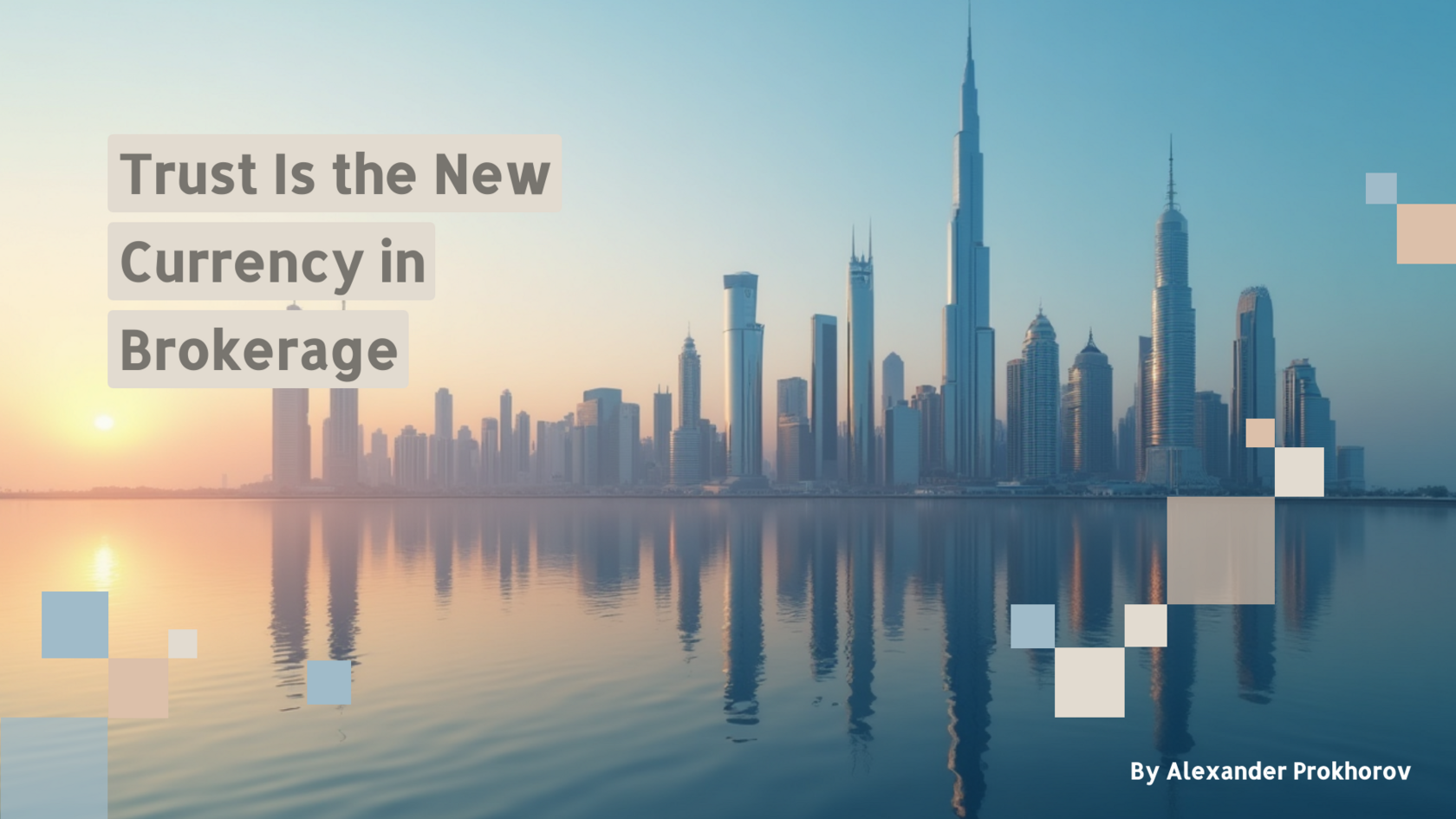
In the evolving landscape of real estate—particularly in fast-moving, high-opportunity markets like Dubai—the concept of trust is rapidly being digitized. Programs such as "True Broker" reflect an important shift: recognition and credibility are no longer just built through years of quiet diligence or whispered referrals. They're increasingly quantified, surfaced, and amplified through intelligent platforms.
And this is not necessarily a bad thing.
Over the past decade, I’ve worked closely with developers, planners, and market analysts across diverse geographies. What becomes clear—whether you’re in Singapore, Berlin, or the UAE—is that success in real estate increasingly depends on visibility married to credibility, and technology plays the bridge. A True Broker isn't simply an algorithmic success story; they’re an early participant in a broader transformation: where personal brand, market insight, and technological alignment converge with extraordinary efficiency.
Yet beneath the metrics—more leads, faster sales, leaderboard rankings—there’s a more meaningful layer about specialization and human connection. True Brokers, by design or by default, position themselves as hyper-local experts. In a city like Dubai, where urban fabric can shift dramatically from one neighborhood to the next, that level of specialization matters not only for sales but for stewardship. Clients aren't just reaching out for transactions—they’re seeking interpreters of place.
That role, when taken seriously, edges us closer to a more human-centric model of real estate—where knowledge isn’t merely power, but a form of service. A True Broker, in this light, acts as both expert and guide, applying market intelligence toward an emotionally intelligent outcome: homes that fit, investments that align with long-term urban visions, and neighborhoods that feel coherent over time.
It also nudges the profession toward transparency. In a world where data flows openly and reputations are charted in real time, we move from opaque networks to partially democratized trust. Of course, this has implications. It levels the playing field but also pressures agents to constantly prove, optimize, and display their value.
We should remain mindful that not all value is immediately measurable. Some of the most profound contributions in real estate occur long before, or long after, any transaction. So while leaderboard optics are motivating—and operationally effective—we must ask: how can technology continue to reinforce not just volume, but meaning?
Real estate is, at its best, a long game. When platforms like True Broker help elevate honest professionals, foster clear relationships, and sharpen accountability, they’re not just transforming agents—they’re fine-tuning the ecosystem of trust within which future cities will evolve.
And perhaps the quiet question behind all of this is: in an increasingly verified world, what will become the new markers of authenticity? 🌍
And this is not necessarily a bad thing.
Over the past decade, I’ve worked closely with developers, planners, and market analysts across diverse geographies. What becomes clear—whether you’re in Singapore, Berlin, or the UAE—is that success in real estate increasingly depends on visibility married to credibility, and technology plays the bridge. A True Broker isn't simply an algorithmic success story; they’re an early participant in a broader transformation: where personal brand, market insight, and technological alignment converge with extraordinary efficiency.
Yet beneath the metrics—more leads, faster sales, leaderboard rankings—there’s a more meaningful layer about specialization and human connection. True Brokers, by design or by default, position themselves as hyper-local experts. In a city like Dubai, where urban fabric can shift dramatically from one neighborhood to the next, that level of specialization matters not only for sales but for stewardship. Clients aren't just reaching out for transactions—they’re seeking interpreters of place.
That role, when taken seriously, edges us closer to a more human-centric model of real estate—where knowledge isn’t merely power, but a form of service. A True Broker, in this light, acts as both expert and guide, applying market intelligence toward an emotionally intelligent outcome: homes that fit, investments that align with long-term urban visions, and neighborhoods that feel coherent over time.
It also nudges the profession toward transparency. In a world where data flows openly and reputations are charted in real time, we move from opaque networks to partially democratized trust. Of course, this has implications. It levels the playing field but also pressures agents to constantly prove, optimize, and display their value.
We should remain mindful that not all value is immediately measurable. Some of the most profound contributions in real estate occur long before, or long after, any transaction. So while leaderboard optics are motivating—and operationally effective—we must ask: how can technology continue to reinforce not just volume, but meaning?
Real estate is, at its best, a long game. When platforms like True Broker help elevate honest professionals, foster clear relationships, and sharpen accountability, they’re not just transforming agents—they’re fine-tuning the ecosystem of trust within which future cities will evolve.
And perhaps the quiet question behind all of this is: in an increasingly verified world, what will become the new markers of authenticity? 🌍